
Do Solar Panels Work from Heat or UV Rays?
Many people assume solar panels generate electricity from heat, while others believe it’s the sun’s UV rays doing all the work. In reality, neither explanation tells the full story. The real answer lies in something called photons.
Photons are tiny packets of energy that are produced from the suns light. But light is actually made up of different types of electromagnetic radiation, including ultraviolet (UV) light, visible light and infrared (IR) radiation, each producing photons with different amounts of energy.
So, solar panels don’t specifically use UV rays to generate electricity. Instead, they capture photons given off by light sources like UV rays with just the right amount of energy. Hence, solar panels generate electricity from light rather than heat. In fact, while bright sunshine increases energy production, excessive heat can actually reduce a panel’s efficiency.
So, how do billions of tiny photons travel from the sun and become the electricity powering your home or business?
Let’s follow the journey.
It Starts 150 Million Kilometres Away
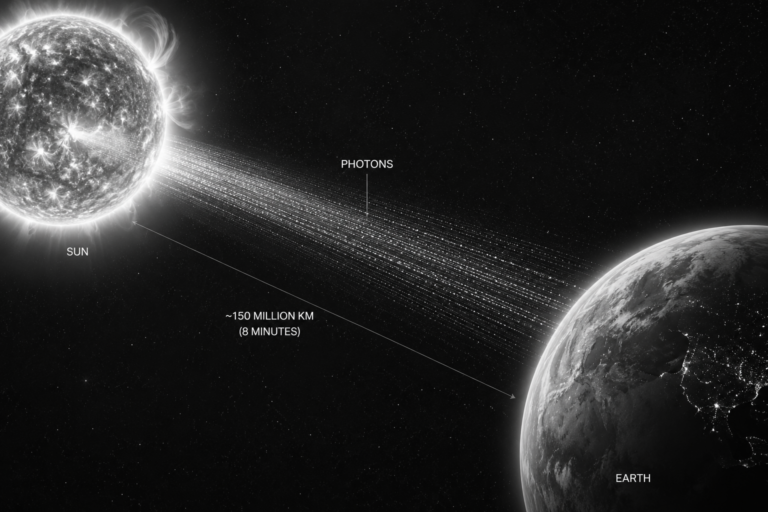
Every second, deep within the core of the sun, billions of hydrogen atoms collide under immense pressure and temperatures of around 15 million degrees Celsius. These collisions trigger a process called nuclear fusion, where hydrogen atoms combine to form helium, releasing an extraordinary amount of energy.
That energy begins an incredible journey. It can take thousands of years to move from the sun’s core to its surface, where it is finally released into space as billions upon billions of photons. These photons are the tiny packets of energy that make up the sunlight travelling towards Earth.
Each individual photon carries only a tiny amount of energy, but the sun produces an almost unimaginable number of them every second. By the time they reach Earth, enough solar energy arrives in just one hour to meet the world’s electricity demand for an entire year if it could all be captured and utilised.
Step 1: The Solar Panels Capture the Light
Solar panels are made up of hundreds of photovoltaic (PV) cells, most commonly manufactured from silicon, a highly efficient semiconductor material.
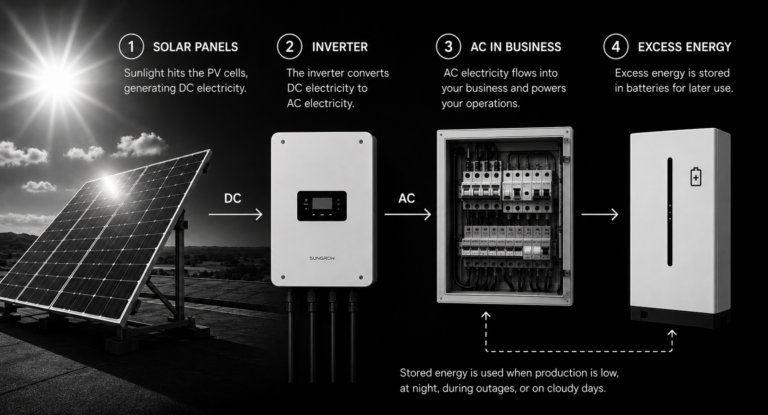
When sunlight strikes the panels surface and reaches these cells, the incoming photons transfer their energy to electrons within the silicon atoms. This extra energy allows the electrons to break free from their atomic bonds and begin moving through the cell. The movement of millions of these electrons creates a strong electrical current that flows in a single direction through the panel. The electricity produced is known as Direct Current (DC).
This entire process is known as the photovoltaic effect. Rather than using heat to generate power, Solar PV systems harness sunlight through the photovoltaic effect to produce clean, renewable electricity. It’s also where the term Solar PV, commonly used throughout the renewable energy industry, gets its name.
Step 2: The Electricity Travels to the Inverter
The DC electricity produced by the solar panels now travels through specialised cabling to the inverter. The inverter is often called the “brain” of the solar system because it converts the electricity into a form of current your building or home can actually use. Solar panels produce Direct Current (DC). Your lights, computers, machinery, refrigeration, pumps and air conditioners all operate on Alternating Current (AC).The inverter performs this conversion almost instantly, allowing the electricity to power your business.
Step 3: Your Building Uses the Solar Energy First
Once converted into AC electricity, the power flows into your building’s distribution board. From there, it is supplied directly to your electrical circuits. One of the biggest advantages of solar is that your building uses the energy it’s generating first before drawing electricity from the grid. That’s where the savings begin.
Step 4: What Happens to Excess Energy?
There are times during the day when your solar system produces more electricity than your building is using. Rather than letting that energy go to waste, it can be used in several ways.
Battery Storage
If your system includes batteries, the excess electricity is stored for later use. The batteries hold this energy until it’s needed, whether that’s after sunset, during cloudy weather, or when there’s a power outage. Instead of relying on the grid, your business or home can continue using the clean energy it generated earlier in the day.
Exporting Back to the Grid
Some commercial systems are designed to export surplus electricity back into the municipal or utility grid, where regulations allow. This helps ensure that every unit of electricity generated delivers value.
From Sunlight to Savings
In just a few seconds, sunlight travels from the sun, strikes your solar panels, becomes electricity, passes through an inverter, powers your building and, if not immediately needed, is stored in batteries for later use.
It’s an extraordinary process that happens quietly every day.
At 365 Solar, we design, engineer, install and maintain commercial and industrial solar PV systems that help businesses harness the power of the sun, reduce electricity costs and build a more sustainable future.
Because when design meets efficiency, every ray of sunshine has the potential to power something bigger.
Call 365 Solar today to discuss how we can turn your business’s energy consumption, into an asset, rather than an expense. Let’s secure your energy future.