
before prices rise: A 2026 Energy reality Check
South African households and businesses are bracing for continued electricity cost increases. After a NERSA-approved tariff rise of ~12.7 % from April 2025, further hikes of around 5.4% were forecast for 2026, but new proposals now suggest increases closer to 8–10 % as regulators revisit revenue needs — effectively pushing total electricity price inflation close to or above 18 % this year and beyond.
These hikes deepen the strain on already stretched household budgets and business operating costs. As Eskom tariffs continue to climb well above inflation, the cost of doing nothing is becoming more expensive than the cost of investing in alternative energy solutions. This is where solar power in South Africa moves from a “nice-to-have” to a strategic necessity.
Solar Energy as the Financial Solution
The South African solar market is expanding rapidly. Forecasts show the industry set to grow by USD 5.46 billion (≈ R90 billion) between 2024 and 2029 at a CAGR of 38 %, with installations increasing at roughly 30 % year-on-year.
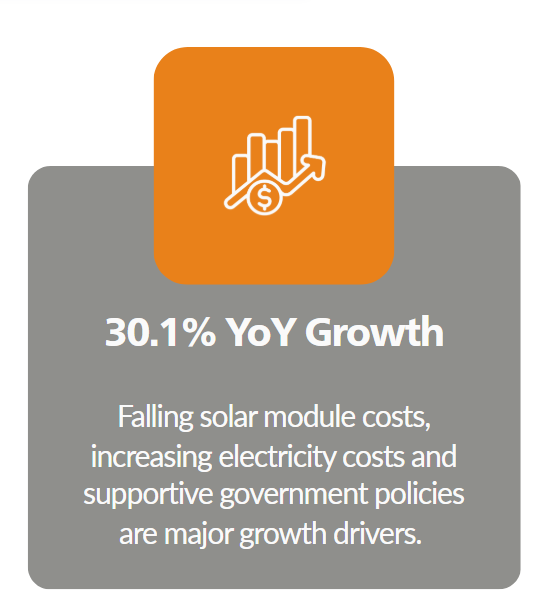
This dramatic expansion is propelled by improving technologies, declining panel costs, financing models like PAYG, and supportive policy moves.
Solar energy offers protection against tariff volatility. While Eskom prices rise annually, the cost of producing electricity from a solar system remains largely fixed once installed. Every tariff increase therefore improves the value of solar, widening the gap between grid costs and self-generation.
Faster ROI: Why the 18% Electricity Hike Changes the Math
One of the most important shifts in 2026 is the accelerated return on investment (ROI) for solar systems. Due to the effective 18% electricity price increase, many residential and commercial solar installations are now seeing their payback periods reduced by 2 to 3 years.
What may previously have been a 7–8 year ROI can realistically drop to 5–6 years or less, depending on usage and system size. For businesses, this translates into stronger cash flow, improved cost certainty, and higher long-term savings. For households, it means faster relief from rising utility bills and greater lifetime value from their investment.
For those who already have solar installed, the message is clear: your system just became significantly more valuable. For those still considering it, installing before further price hikes allows you to offset rising costs immediately rather than absorbing inflated tariffs while waiting.
Grid-Tied vs Off-Grid Solar in 2026
Advantages
Lower upfront cost compared to fully off-grid systems
Ability to offset daily electricity usage
Potential to feed surplus energy back into the grid where tariffs allow
Considerations
Continued exposure to fixed Eskom charges
Compliance and registration requirements remain essential
Advantages
Full protection from electricity price hikes
Predictable energy costs
Long-term energy security
Considerations
Higher upfront investment due to batteries and backup systems
Requires careful system sizing and energy management
Business Compliance and Electricity Standards for 2026
Investing in solar isn’t just about installation, you must also stay compliant with South African electricity regulations. In 2026, legal compliance and grid connection standards matter more than ever for businesses and households with solar:
Any grid-tied solar system under 100 kVA must be registered with Eskom or your local municipal electricity provider, as mandated under the Electricity Regulation Act. This applies even if you don’t export power back into the grid.
Businesses with larger systems above 100 kVA must register directly with the National Energy Regulator of South Africa (NERSA).
Eskom has simplified and lowered barriers for compliance by allowing solar installations to be signed off by Department of Employment and Labour-registered electricians instead of only Engineering Council (ECSA) professionals.
This reduces cost and approval timelines for both residential and commercial solar adopters.
For systems up to 50 kVA, Eskom has waived registration and connection fees. Including smart meter installation. Helping commercial and residential customers reduce upfront compliance costs.
Installers must provide a Certificate of Compliance (CoC), inverter certification (e.g., NRS097-2-1 standard), and an embedded generation test report to meet grid safety and legal requirements.
Understanding these compliance frameworks is essential. Registered systems not only avoid legal penalties but also unlock benefits like export credits under the Homeflex tariff and participation in future grid support and demand response programmes.
Fully off-grid systems, on the other hand, don’t require registration as long as they are truly independent from Eskom’s network but businesses must ensure their internal electrical systems comply with the same safety and performance standards insurers and regulators expect.
The 2026 Energy Strategy: Invest Before Prices Rise
South Africa’s electricity future is clear: prices will continue rising. The real decision is whether that money goes toward escalating utility bills or toward renewable infrastructure that delivers long-term value.
By redirecting the equivalent of an 18% electricity increase into solar and energy storage:
You reduce exposure to future tariff hikes
Accelerate your return on investment
Improve budget certainty
Increase property and business resilience
Before prices rise further, solar stands out as the most practical, cost-effective energy solution for 2026 and beyond.